BioPath | 10-min Pitch Deck Keys: PgDown/PgUp or scroll

Slide 1 · What we do

BioPath turns farm maps into measurable trap-placement decisions.

Two-line investor version: one layout in, optimized trap coordinates out, with benchmark uplift. We monetize via paid pilots that convert into annual decision-support subscriptions.

Clear in two lines Concrete example first No jargon opening

Concrete memory anchor

In a Cambridge-style farmyard, teams repeatedly miss one feed-corridor route and one storage-edge bottleneck. BioPath returns six coordinates and measurable uplift in one run.

Memory sentence: Map in. Traps out. Proof attached.
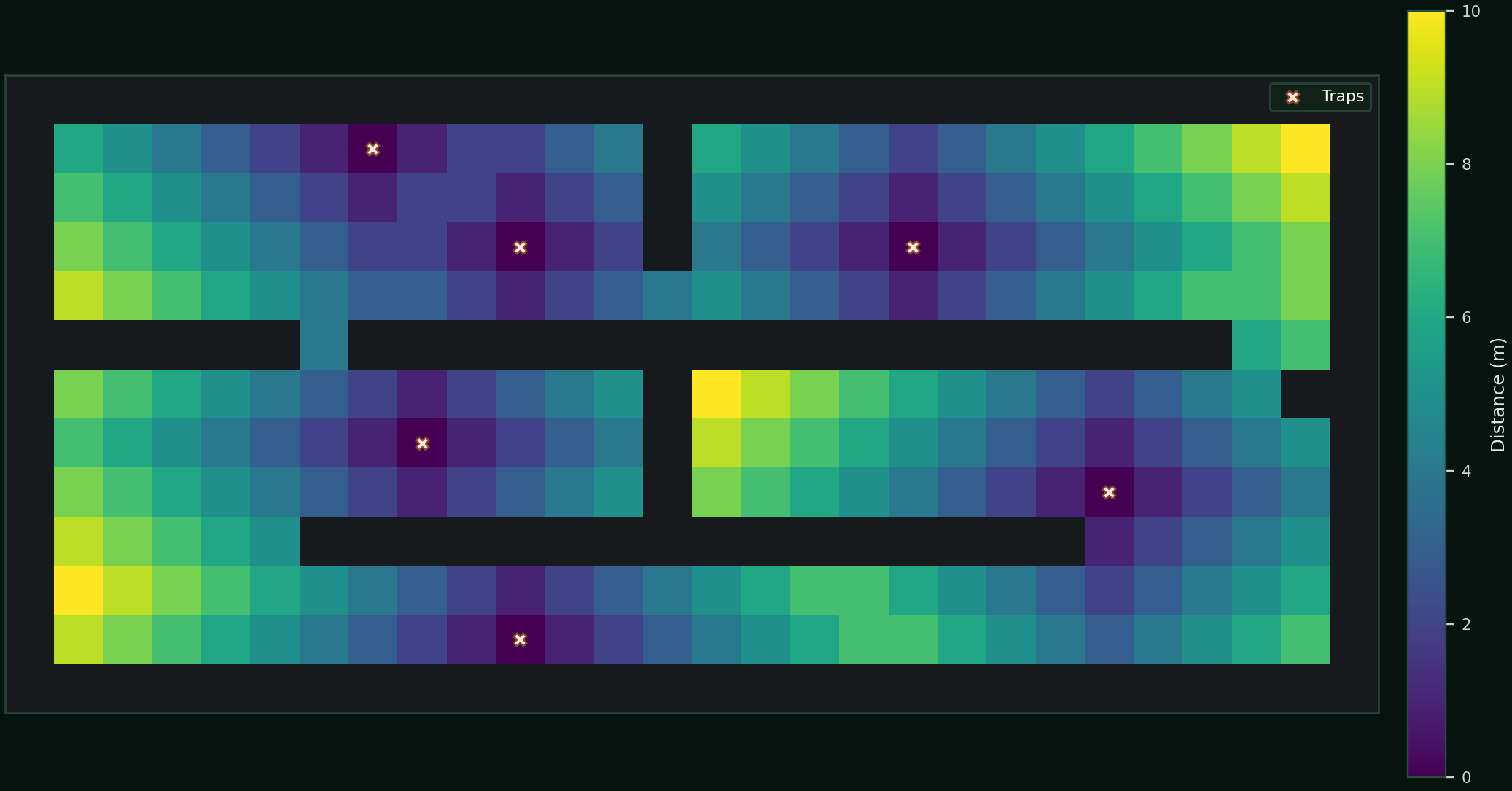
Optimized heatmap and trap plan
Visual proof used in the live segment.

Slide 2 · Problem + customer

Manual trap placement is experience-heavy, hard to standardize, and difficult to audit.

Primary customers

  • Farm operations teams running complex layouts.
  • Pest-control operators managing multiple sites.
  • Secondary stakeholders: managers/procurement/compliance reviewers.

Observed pain pattern

  • Blind spots near chokepoints and storage edges.
  • Repeat re-positioning with weak evidence trail.
  • Hard handover between technicians and shifts.

Slide 3 · Product conversion chain

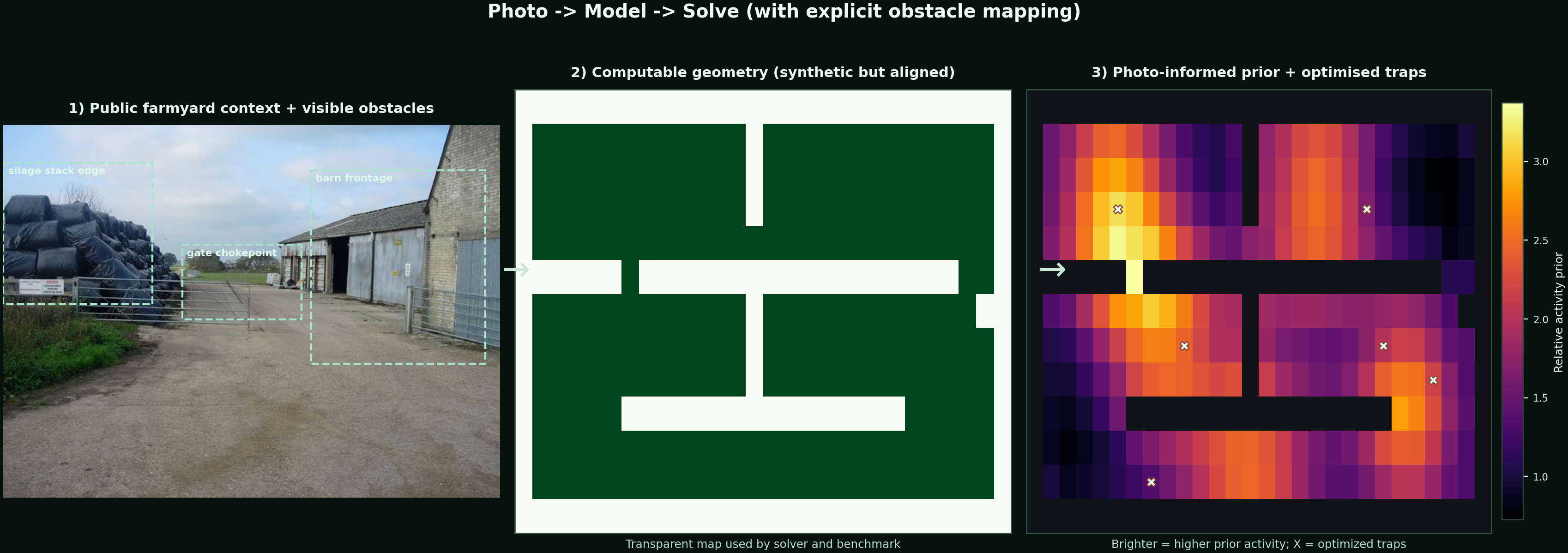
Source -> model -> solve is transparent, bounded, and reproducible.

Photo to model to solve conversion chain
Real context photo informs synthetic geometry + risk prior used by solver and benchmark.

2-minute user flow

  1. Upload site layout/map and set trap budget.
  2. Run solve to generate trap coordinates.
  3. Run benchmark versus heuristic baseline (same k).
  4. Read proof contract and export run artifact.

Deliverable: coordinates + evidence summary + rerunnable configuration.

Slide 4 · Technical edge

Originality is scenario-robust decision under uncertainty, not static rule heuristics.

Method stack

  • Walkable grid/graph representation.
  • Stochastic movement modelling for uncertainty.
  • Fixed-budget optimization over candidate traps.
  • Monte Carlo validation across scenarios.

Proof contract definition

  • Primary comparator: rule-based heuristic baseline (edge + spacing prior), not pure random.
  • Robust score: conservative capture under uncertainty scenarios (scenario-min behavior).
  • Auditability: each run saves assumptions, outputs, and artifact paths.

Slide 5 · Traction + measurable proof

Execution speed is demonstrated by a closed loop: solve -> benchmark -> artifact -> rerun.

Current proof snapshot (k = 6, MC N = 140)

Optimized capture59.3%
Heuristic baseline40.7%
Uplift vs heuristic+45.6%
Robust capture38.6%
Random baseline34.1%
Secondary uplift+74.0%

Same budget, explicit comparator, uncertainty-aware robust metric.

Traction signal today

  • End-to-end stack live: solver, API, benchmark, pitch studio.
  • Pitch Safe mode keeps demo stable without API dependency.
  • Run artifacts generated per cycle for reviewer inspection.
  • Founder-driven iteration cycles completed in hours, not weeks.

Slide 6 · Market + pricing

Bottom-up commercial path: paid pilot -> annual subscription -> multi-site expansion.

SAM and channel logic

  • UK holdings: ~209k; practical starting SAM is high-output farms (~15k in England).
  • These ~15k are ~16% of farm businesses but represent ~78% of output.
  • BPCA has 700+ member pest-management firms as a channel pool.
  • At 1% of 15k (150 sites), ARR at £9k/site is ~£1.35m.

Sources: GOV.UK farming evidence · BPCA.

Pricing + 3–5y ambition

  • Pilot: £5k for 8 weeks per site.
  • Subscription: £9k per site per year.
  • Value anchor: save ~1 technician day/month on rework + handover + audit reporting.
  • Conversion assumption: 35% pilot -> subscription.
  • 3–5y SOM target: 30–70 sites (ARR ~£270k–£630k).

Operator channels can spread software cost across multiple client sites, improving unit economics versus single-site procurement.

Three-scenario path (for judge realism check)

Scenario Y3 pilots Y3 active sites Y3 ARR (subscription only) Y3 total revenue
Conservative 15 ~4 ~£36k ~£111k
Baseline 35 ~9 ~£81k ~£256k
Optimistic 50 ~15 ~£135k ~£385k

Same pricing assumptions, different pilot throughput and conversion realism.

Slide 7 · Finance + funding path

Finance is staged and practical: conservative costs, explicit milestones, and fund-to-outcome traceability.

Near-term finance baseline

  • Year-1 cash cost base: £28k (cloud + pilot execution + essential operations).
  • Boundary note: founder build time is in-kind at this stage.
  • 18–24 month outputs: repeatable uplift evidence + first recurring contracts.

Use of funds: pilot evidence generation, product reliability, and conversion-ready delivery assets.

Funding route now

Currently applying through CREGS + LINCAM PoC. Official Ceres pages list PoC awards at £5,000–£20,000 and a 7-minute pitch format.

Official pages: LINCAM PoC details · Ceres collaboration page (accessed 24 Feb 2026).

What the money buys in 12 months

Pilot evidence engine 40%
Product reliability + reporting 35%
Channel + compliance readiness 25%

Funding is staged against concrete outputs, not abstract team expansion.

Slide 8 · Team + explicit ask

Execution trust: founder-problem fit, direct ask, and milestone accountability.

Why this team can execute

  • Xiaoxiao Zhouyi, Founder & Sole Builder.
  • PhD Candidate in stochastic processes (movement uncertainty modelling).
  • Built BioPath end-to-end: model, API, benchmark, web pitch stack.

Ask now

  • Two pilot introductions (farm/operator partners).
  • One 8-week practical data-access trial site.
  • One support letter for a £5k–£20k LINCAM PoC application.
  • Expected return: validated uplift evidence + first recurring contracts.

12-month success definition

  • Two completed pilots with comparable benchmark contracts.
  • At least one pilot converted to paid annual subscription.
  • Standardized evidence pack accepted in real review meetings.